Democratic Landscape Transformation 2025 - Team 10
>>> Back to working group overview
>>> Back to seminar reading list, session materials & recordings
>>> go to the Editing Help
Seminar process at a glance

Background of your team
Please present your team briefly. Which linguistic and cultural perspectives does each member bring in? Which disciplinary backgrounds are present in your team? Note: if you prefer to stay anonymous on this wiki, you can also use initials only or a nick name
- Francesca Mazza, a dedicated Italian Landscape Architect with a profound commitment to creating green spaces that harmonize with urban environments. Her work emphasizes environmental sustainability and the regeneration of public areas, reflecting her belief in the transformative power of well-designed landscapes. With extensive experience in collaborating on diverse projects, from public parks to comprehensive urban regeneration efforts, Francesca is adept at integrating ecological principles into her designs. She understands the importance of fostering community engagement and enhancing the quality of life through thoughtfully planned outdoor spaces.
- Salar Asefi, is an architect from the Azerbaijan region in northwest Iran, where his cultural and geographical background has greatly influenced his approach to urban and landscape design. His recent work focused on Lake Urmia, addressing its environmental and social implications, as he believes that landscape design should respond to the pressing needs of both people and nature. His design philosophy is rooted in the principles of community involvement and sustainable architecture, with a particular emphasis on façades, public spaces, and people-centered design. He advocates for a design process that incorporates diverse perspectives—both supportive and critical—ensuring that all voices are heard in shaping the future of urban spaces.
- Shabi Khan, is an Indian architect and landscape designer with over seven years of international experience spanning India, Saudi Arabia, Dubai, and the United States. He is currently pursuing a Master's in International Landscape Architecture at Nürtingen-Geislingen University in Germany. Shabi’s work focuses on sustainable Architecture and Landscape Design, shaped by his hands-on experience and a global design perspective. Notably, he contributed to impactful projects with the Office of Lou Arencibia in New York, further honing his approach to environmentally responsive design. Originally from New Delhi, India, Shabi brings a deep personal connection to the challenges of urban growth and environmental degradation. Through both his professional and academic work, he is dedicated to creating meaningful, people-centered landscapes that support long-term ecological balance.
- Tabby Ngii, is a Kenyan Landscape Architect who brings a rich intersection between lingustic diversity and cultural depth. Growing up in a multilingual society, she's fluent in English and Kiswahili, and understand the power of language in shaping narratives and bridging communities. Her Kenyan heritage rooted in communal values, ecological awareness and deep respect for land, grounds her design approach which is shaped by both rural and urban Kenyan Landscapes, where storytelling, collective identity, and traditional ecological knowledge guide place-making. She contribute a perspective rooted in inclusivity, adaptability, and a strong connection between people and nature.
- Vitória Gonçalves, is a Brazilian architect and urban planner committed to a social and democratic approach to architecture—one that is fundamentally centered on people, especially those who are often marginalized due to race, economic status, or gender. With experience in the development of public space projects such as urban squares and parks, Vitória views these spaces as vital instruments for social and environmental transformation, enhancing the quality of life in cities. As a researcher, she also holds a particular interest in interventions in historic centers—sites rich in memory and essential to the cultural identity of communities. Her work is grounded in social sensitivity, ecological awareness, and the appreciation of local narratives, always striving to co-create more just, resilient, and vibrant urban environments.
Your Landscape Democracy Manifestoes (Phase A)
Here you can add here the links to the manifestoes you have presented on April 23. Please make sure that the links are accessible. You can also add them directly here on the wiki, they need to be png or jpg format then.
- Francesca Mazza, The Reconversion of Stables Montel in San Siro
- Salar Asefi, Urmia lake, a landscape in crisis
- Shabi Khan, Save Himachal
- Tabby Ngii, Shaping Just, Resilient and Inclusive landscapes
- Vitória Gonçalves, Landscape is a right, Against Floods and Environmental Injustice in Ponte Nova - Brazil
Entering the Process: Activism, Community and Power (Phase B)
Global Landscape Democracy Role Models and Design Activism
- Due: May 14
At the beginning of phase B we ask you to identify people who are already active for democratic landscape transformation. These can be planners and designers, NGOs, collectives or activists, or people operating creatively at the interface of these categories. 'Design activism' is a possible overarching category. We created a list some time ago, but it has a very US/European focus, due to the history of our project. We really want to expand this and hope you can bring in new people and movements from around the globe.
On May 14, every team member introduces a landscape democracy activist/or design activist individual or group. Please add the people you introduced, you may also add the presentation material used with a downloadable link:
- Francesca Mazza, Naomi Klein: Environmental Activist, Journalist, and Author
- Salar Asefi, Kaveh Madani: Science, Activism, and Environmental Justice
- Shabi Khan, Vandana Shiva: Founder - Navdanya Movement
- Tabby Ngii, KDI: Participatory, environmental, and spatial justice activist
- Vitória Gonçalves, Sustainable Favela Network
Your Team's Landscape Democracy Challenge (Phase B)
- Due: May 21

Context and Location
Briefly describe here the context the landscape democracy challenge you selected on April 23, 2-3 sentences, you may add the link to the manifesto that already exists
Sanjauli is a major and densely populated part of Shimla, located in the Himalayan state of Himachal Pradesh, India. Although known for its scenic mountains, forests, and natural springs, the region is increasingly vulnerable due to unsustainable development, climate change, and unplanned tourism growth.
Rapid urban expansion, infrastructure pressure, and disregard for the local ecological balance have contributed to a growing landscape crisis. This calls for a collective response to acknowledge, address, and act on urgent spatial and environmental challenges — as highlighted in the Save Himachal Manifesto. This Manifesto is a call to acknowledge, address and act on the pressing landscape issues.
Landscape and Community Map
Present here a visual representation of the landscape and community context of the area. What are the main spatial features? Which actors can you identify and how are they related to the area? Which values exist and for whom? What is at risk and why? Try to generate creative/conceptual/synthetic representation

Our map visualizes the key territorial layers, stakeholders, and pressures acting on the Sanjauli landscape. It identifies natural and built features, such as mountains, springs, forests, traditional villages, and tourism infrastructure.
The community is affected by issues like:
- Unplanned urbanization
- Loss of traditional landscapes
- Soil erosion and landslides
- Degraded natural areas
- Drying water sources
We highlight the interactions between communities (local residents, tourists, developers, and government) and their often-conflicting interests, especially regarding land use, conservation, and tourism. At the center of the map are the vulnerable landscapes and communities — which must be protected through democratic, inclusive, and context-based planning.
Power Map
Based on the landscape and community context depicted above: How is power distributed? Who and what has a lot of power? Who and what has no power? Who and what is strongly affected by the landscape democracy challenges? Who and what is less affected? Are these actors connected or disconnected? Any veto-players known? Try to generate creative/conceptual/synthetic representation

This power map helps us understand how decision-making power is distributed in Sanjauli, and how different actors relate to the ongoing landscape democracy challenges.
On the left side, our agenda promotes a resilient Himachal, where development respects natural topography, local culture, and ecological limits. Actors aligned with this vision include:
- Local environmental NGOs, landscape architects, and community leaders, who play active roles in advocating for sustainable planning;
- Local residents, researchers, and schools, who may be affected but often lack direct influence;
- Developers who show support when involved in context-sensitive projects.
On the opposing side, the right side of the map represents agendas driven by unregulated tourism, rapid urbanization, and economic exploitation. Here, powerful actors like:
- Local politicians, the Himachal Tourism Department, and investors, often drive top-down decisions with little community involvement.
Although local tourism entrepreneurs appear on both sides, their role is complex — they are both affected by and contributors to the transformation of the landscape, depending on their approach.
Additionally, we acknowledge the role of international solidarity, with figures such as Vandana Shiva and Naomi Klein symbolizing broader support for environmental justice and democratic participation.
This power map reveals that many key stakeholders in favor of sustainable transformation have limited decision-making power. Bridging these gaps and strengthening coalitions is crucial to advance more inclusive, place-based, and democratic landscape interventions in Sanjauli.
Your Team's Landscape Democracy Vision and Ideas (Phase C)
- Due: June 18
Collective Vision
If you were to redesign the power map of your area and start a process of democratic landscape transformation: Which long term-goal could keep the process going? What could be a collective vision that integrates the goals of your team? Give a name to your vision. Try to generate creative/conceptual/synthetic representation.
Our vision is reimagine Sanjauli as a living, walkable, and inclusive landscape, peaceful, connected, and full of wonder. A place that welcomes children, tourists, the rich and the poor alike; where every person feels a sense of dignity, belonging, and joy. Let it be a land where memories are created, dreams take root, and no voice is left unheard. A home that the community cherishes and always longs to return to.

A prototype of the first step
How would you enter the process? Which prototype could activate it? How would you introduce the prototype to the community?
Prototype as Engagement
To initiate our vision, we designed Baithak Chowk — a semi-circular public seating space aimed at activating dialogue, participation, and shared experience in the heart of Sanjauli’s local market area.
This prototype was developed to test how public space can promote rest, encounters, social exchange, and belonging, while respecting the physical, social, symbolic, and temporal context of the community.


Testing Questions
We explored multiple dimensions:
- Physical feasibility: comfort, durability, placement, shape
- Social feasibility: inclusion of elders, women, youth; fostering interaction
- Emotional / symbolic value: sense of ownership and connection
- Material, color, and shape testing
- Temporal feasibility: use during and beyond market hours
Physical Aspects
- Type: Physical pop-up model; Virtual visualization + 3D plan with amphitheater layout.
- Design features: A circular stepped seating, promoting visibility and equality. An elevated platform with pergola for speakers, facilitators, or performers. Integration of local stone and wood elements. Landscaping and potential for greenery integration.
- Material: Reclaimed wood, himachali-style fabric (for shade or accents), local stone masonry, natural and decorative paint and reused pots and eco-conscious finishes.
- Creators: Project team, local youth and community residents who volunteer, carpenters from the community, community artists (embroidery, decoration, painting).
Occasion / Testing Context
- When: During the Tuesday market at Sanjauli bazaar.
- Target users: Market vendors (needing rest), shoppers and passersby, elders resting or waiting, children accompanying parents.
- Interaction: Sitting, resting, observing, conversing or gathering, leaving feedback through boards, stickers, drawings.
Iteration Process – Data Collection
We collected insights through:
- Direct observation (who uses it, how, when)
- Heat mapping of seating preferences
- Interviews with users
- Feedback wall and suggestion box
- Colored sticker system (like / neutral / dislike)
- Photos/videos (with consent)
Ethical Considerations
- Cultural sensitivity: respecting local customs, avoiding religious/political appropriation.
- Gender sensitivity: inclusive and safe for women and girls.
- Accessibility: inclusive seating design for elders and people with disabilities.
- Consent: prior permission for any photo, interview, or data collection.
- Sustainability: local, reused, and non-toxic materials.
- Voluntary participation: no one is obligated to interact or give feedback.
Cross-cutting activity: Readings, concepts and definitions (Phases A - D)
- Due: July 2, 2025
While working in your group, please start to express your personal understanding of the relation of landscape and democracy in the form of a concept map with linking words or any other diagrammatic representation. Please make your maps very visual and not just verbal. Think critically about why one map differs from another.
The final product is a shared concept map that integrates the various understandings present within your team.
About concept mapping
Before starting the exercise you can read this article by Joseph D. Novak & Alberto J. Cañas about Theory Underlying Concept Maps and How to Construct and Use Them. This paper gives a good explanation of how concept maps are conceived and developed.
You can use any tool you like for producing your concept map. However, since the result needs to be submitted digitally we recommend the following open source software for producing your maps:
- Cmap Tools >>> you can also work with your group on the Cmap cloud doing a shared map
- VUE - The Visual Understanding Environment
- Use a shared whiteboard to develop your integrated concept map, such as MIRO or MURAL
How to present your concept maps
- Possible format: JPG (for wiki upload) or link to any other resource
- We give you below a draft image gallery where you can add pictures of your map (in JPG or PNG format)
- You can present your integrated understanding as one concept map or your present individual ones and the integrated one.
- add as many additional materials as you need
Overview of your concept maps (individiual and integrated)
Individual Concept Map
This section presents the individual concept maps created by each team member as a way to reflect on the connection between landscape and democracy. Each map represents a personal interpretation of key ideas, relationships, and values that shape democratic transformation through space. These visualizations served as a foundation for discussion and the development of our final integrated concept map.
-
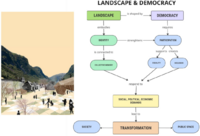 Francesca Mazza
 -
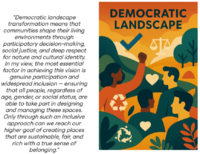 Salar Asefi
 -
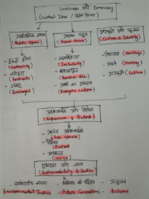 Shabi Khan
 -
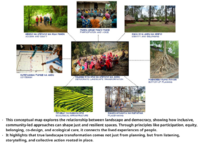 Tabby Ngii
 -
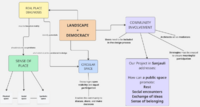 Vitória Gonçalves


Integrated Concept Map
This Integrated Concept Map illustrates the central role of public space as a connector between landscape, democracy, and transformation. It demonstrates how inclusive and participatory public spaces can serve as platforms for community dialogue, cultural expression, and equitable development.
- From the landscape dimension, public space is rooted in heritage, culture, identity, and collective memory, shaping the way people relate to their environment.
- From the democracy perspective, public space enables equity, inclusion, and active participation, essential for democratic engagement.
- In terms of transformation, public space acts as a site for sustainable co-design, social service, and policy-driven change, supported by diplomacy and collaborative governance.
Altogether, the map expresses a vision of transformation that emerges from place-based knowledge, democratic values, and shared responsibilities—where public space is both a meeting ground and a catalyst for change.
Please finish with a short reflection (Phase D)
Due: July 9, 2025
- What are the similarities and differences in your team regarding your understanding of what democratic landscape transformation is?
- In how far did the seminar lectures and readings help you to clarify this?
- What will you take home from this seminar?