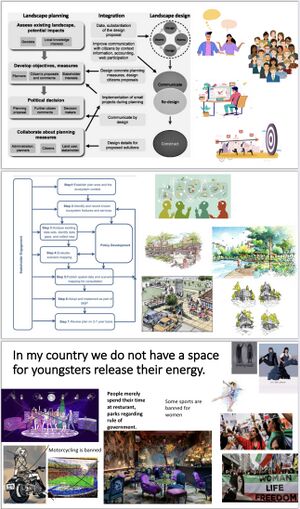
In the session on May 10 you will discuss examples of landscape activism from your own contexts. You can share the examples in this section (link, image and/or short explanation).
In the session on May 17 you will present a small role play with your team. Please add here a short reflection on what you have learned from this play. The short list of landscape democracy 'movers and shakers' can be found here
>>> All information on the phase B activities is compiled in this PDF
Readings, concepts and definitions
Start: April 5, 2023
Due: July 5, 2023
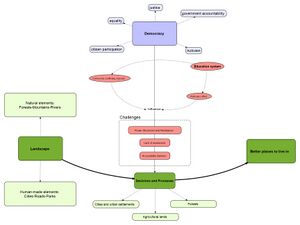
Working in your group, express your personal understanding of the relation of landscape and democracy in the form of a concept map with linking words or any other diagrammatic representation.
Please make your maps very visual and not just verbal. Think critically about why one map differs from another
You can use any tool you like for producing your concept map. However, since the result needs to be submitted digitally we recommend the following open source software for producing your maps:
Cmap Tools >>> you can also work with your group on the Cmap cloud doing a shared map
What are the similarities and differences in your team regarding your understanding of what democratic landscape transformation is?
The differences we faced were more about related to the process some of us thought it as a linear process and some more like a complex process. The similarity that we all agree on is that we all effect on the way we approach to landscape democracy and the importance of it.
In how far did the seminar lectures and readings help you to clarify this?
It actually helped but we think that is more of a personal approach which might be easily influenced but not totally change our beliefs , but a very important thing to mention is also that we find it very helpful the inputs and the readings which effected the way we think now.
What will you take home from this seminar?
We will take home many things from this module, for example like how we transfer the landscape designing process and making it more democratic and inclusive. Another important thing is how to also implant everything we have learned and to spread our knowledge to different stakeholders we will be facing to different processes.