Seminar process: Click to enlarge. We meet weekly online at 18 pm CET on Wednesday from April 2 to July 2, an additional meeting opportunity is weekly from 12 00 - 13 00 pm CET
Background of your team
Please present your team briefly. Which linguistic and cultural perspectives does each member bring in? Which disciplinary backgrounds are present in your team? Note: if you prefer to stay anonymous on this wiki, you can also use initials only or a nick name
Magnus Nupan, a landscape architect from Iceland, is dedicated to the preservation and enhancement of biological diversity. His enthusiasm for urban farming ignited his passion for landscape architecture.
Mhd Karam Al shamaa I’m originally from Syria and currently living in Germany. My academic journey took me through Syria, Jordan, and Germany, where I studied and worked in architecture and urban development.My passion lies in sustainable design, cultural heritage, and how landscape can support social inclusion and democracy
Fatemeh Kardan, an Iranian architect and urban planner, is committed to the creation of high-quality urban spaces in her home country. With professional experience in governmental urban development projects in Iran, she is currently pursuing a Master's degree in Landscape Architecture at the University of Bologna. Her passion for improving the quality of urban life has guided her journey from public sector work to academic exploration, with a strong focus on designing inclusive, sustainable, and livable environments.
Maliyah Hatchell, a landscape architect from the United States. I got into landscape architecture because of my affinity for the environment. With how rapidly the world is changing, I believe it's become very important to put sustainability at the forefront of design. I'm currently studying landscape architecture at the University of Maryland and have found that I love working with community engagement, as well as site and habitat restoration.
Md. Sadi Murshed Bhuiyan, is a Bangladeshi architect with a strong commitment to integrating landscape architecture into socio-economic and environmental solutions. His academic and professional journey reflects a dedication to sustainable urbanism, with a particular focus on promoting approaches that are not only resource-efficient but also equitable and inclusive. Through research and design, he continuously seeks to contribute to the creation of resilient, just, and sustainable urban environments.
team member, xxx
Your Landscape Democracy Manifestoes (Phase A)
Here you can add here the links to the manifestoes you have presented on April 23. Please make sure that the links are accessible. You can also add them directly here on the wiki, they need to be png or jpg format then.
Magnus Nupan, Manifesto - WIND FARMING IN ICELAND, add link
Entering the Process: Activism, Community and Power (Phase B)
Global Landscape Democracy Role Models and Design Activism
Due: May 14
At the beginning of phase B we ask you to identify people who are already active for democratic landscape transformation. These can be planners and designers, NGOs, collectives or activists, or people operating creatively at the interface of these categories. 'Design activism' is a possible overarching category. We created a list some time ago, but it has a very US/European focus, due to the history of our project. We really want to expand this and hope you can bring in new people and movements from around the globe.
On May 14, every team member introduces a landscape democracy activist/or design activist individual or group. Please add the people you introduced, you may also add the presentation material used with a downloadable link:
Md Rakibul Hasan, add link : Tanzil Shafique is a Lecturer of Urban Design and Director of the Postgraduate Programmes at The University of Sheffield School of Architecture. He is also an Associate of the Urban Institute. Previously, he taught at the University of Melbourne, Australia. Tanzil’s research looks at southern urbanism, pluriversal architectural practice and informal planning, mainly focusing on the ongoing adaptation and transformation due to climate change led by the local citizens. He received a British Academy grant in 2021 to convene Decolonial Cities Collective, a transdisciplinary knowledge commons. Additionally, Tanzil co-convenes the Platform for Just Housing (Najjyo Abashon Moncho or NAM) and Bangladesh Climate Alliance, which work towards housing and climate justice with local activists and citizens. Tanzil recently co-authored Off-Grid Toilets (2022), Atlas of Informal Settlements (2023) and his upcoming monograph is titled: City of Desire: An Urban Biography of the Largest Slum in Bangladesh. He is deeply involved in making child-friendly space and co-design in different urban settlements in Dhaka, including the Korail slum.
Md. Sadi Murshed Bhuiyan: Ar. Khandakar Hasibul Kabir is a pioneering figure in Bangladesh's architectural landscape, where his work transcends traditional architectural boundaries to embrace social activism. He won the Aga Khan Award for Architecture for “Urban River Space” project in 2022. Kabir's design philosophy centers on community-driven architecture that bridges social justice with environmental consciousness. His approach emphasizes participatory design processes where local knowledge and traditional building techniques are valued as much as contemporary architectural solutions. At the core of his philosophy is the belief that architecture should serve as a tool for social empowerment, particularly for marginalized communities. Through his work and teaching at BRAC University, Kabir demonstrates how small-scale, bottom-up interventions can create meaningful impact, especially in addressing climate vulnerability and housing rights. His methodology combines vernacular wisdom with modern innovation, focusing on locally available materials and sustainable practices. What distinguishes Kabir's philosophy is his emphasis on 'learning by doing' and the integration of academic knowledge with practical community engagement. His work reflects a deep understanding that architecture is not merely about creating buildings, but about fostering social relationships, environmental responsibility, and community resilience. This approach has significantly influenced both architectural education and practice in Bangladesh, particularly in the development of climate-responsive and socially conscious design solutions.
team member, Mhd Karam Al shamaa
Rasem Badran is a Palestinian architect and urbanist whose work has become a cornerstone of participatory and identity-based design in the Arab world and beyond. Deeply rooted in the cultural and architectural traditions of the Islamic world, Badran views design as a social and moral responsibility. His philosophy transcends formal architecture, positioning design as a vehicle for community empowerment, spatial justice, and cultural revival.
Badran’s activism lies in his deep commitment to human-scale urbanism, where architecture and landscape are tools to restore memory, dignity, and belonging in fragmented or rapidly modernizing societies. Through public projects, mosque complexes, historic revitalization, and masterplans, Badran integrates vernacular traditions with modern needs, always emphasizing the collective memory of place and the emotional connection between people and their environment.
A central pillar of his work is the idea that form should not be imposed but emerge from within the local culture. This belief is mirrored in his participatory design practices that honor community input, especially in the Middle East and North Africa—regions often overlooked in Western-centric planning discourses. Badran uses natural elements like courtyards, water, and shade not just functionally, but as cultural tools to foster inclusion and connection.
Badran’s approach aligns strongly with landscape democracy principles. He supports shifting power to the community by operating at the ‘partnership’ and ‘delegated power’ levels of Arnstein’s Ladder of Citizen Participation. His vision of urban transformation is grounded in social cohesion, cultural resilience, and environmental responsibility.
Rasem Badran’s legacy is not only architectural—it is philosophical and political. His work continues to influence generations of architects and designers, particularly in contexts of post-colonial identity, contested space, and urban inequality.
team member:Fatemeh kardan
Sirous Zare, a local farmer with no formal training in landscape design, became a key landscape activist through his deep commitment to the Kamjan wetland. Over more than a decade, he led grassroots efforts to stop illegal land grabs, negotiated with farmers to restore water flow, coordinated seasonal water management, and mobilized volunteers to clean the wetland—all without official support or funding.Zare’s work exemplifies core principles of landscape democracy: local agency, collective stewardship, and moral legitimacy. Rather than focusing on aesthetics or formal metrics, his approach prioritized community-led restoration and reinhabitation of the landscape. Today, the wetland has revived, migratory birds have returned, and the local community actively protects it.This case reminds us that meaningful landscape transformation often comes not from professionals, but from those who live and work closest to the land.
team member, xxx
Your Team's Landscape Democracy Challenge (Phase B)
Due: May 21
Context and Location
Briefly describe here the context the landscape democracy challenge you selected on April 23, 2-3 sentences, you may add the link to the manifesto that already exists
Location: Korail Slum, Dhaka, Bangladesh.
Landscape type: Urban Informal Settlement
Challenges: democracy, environmental degradation, education, access, power dynamics
Present here a visual representation of the landscape and community context of the area. What are the main spatial features? Which actors can you identify and how are they related to the area? Which values exist and for whom? What is at risk and why? Try to generate creative/conceptual/synthetic representation
Based on the landscape and community context depicted above: How is power distributed? Who and what has a lot of power? Who and what has no power? Who and what is strongly affected by the landscape democracy challenges? Who and what is less affected? Are these actors connected or disconnected? Any veto-players known? Try to generate creative/conceptual/synthetic representation
You can present your results in this gallery:
Your Team's Landscape Democracy Vision and Ideas (Phase C)
Due: June 18
Collective Vision
If you were to redesign the power map of your area and start a process of democratic landscape transformation: Which long term-goal could keep the process going? What could be a collective vision that integrates the goals of your team? Give a name to your vision. Try to generate creative/conceptual/synthetic representation.
A prototype of the first step
How would you enter the process? Which prototype could activate it? How would you introduce the prototype to the community?
You can present your results in this gallery:
Cross-cutting activity: Readings, concepts and definitions (Phases A - D)
Due: July 2, 2025
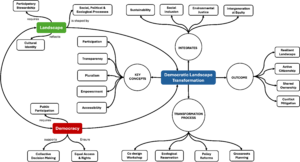
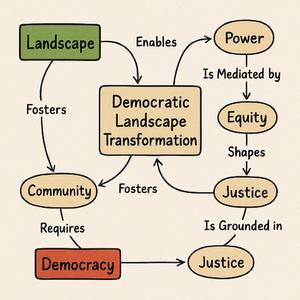
While working in your group, please start to express your personal understanding of the relation of landscape and democracy in the form of a concept map with linking words or any other diagrammatic representation. Please make your maps very visual and not just verbal. Think critically about why one map differs from another.
The final product is a shared concept map that integrates the various understandings present within your team.
You can use any tool you like for producing your concept map. However, since the result needs to be submitted digitally we recommend the following open source software for producing your maps:
Cmap Tools >>> you can also work with your group on the Cmap cloud doing a shared map
What are the similarities and differences in your team regarding your understanding of what democratic landscape transformation is?
As a team, we shared a common understanding that democratic landscape transformation involves inclusive, participatory processes that shape landscapes based on the needs and rights of diverse communities. We all agreed on the importance of public involvement, equity, and sustainability. However, there were differences in how we emphasized certain aspects—some team members focused more on policy and governance, while others highlighted community empowerment and cultural identity. These variations enriched our discussions and made our collective concept more multidimensional.
In how far did the seminar lectures and readings help you to clarify this?
The lectures and readings provided a strong theoretical foundation, introducing us to key terms, case studies, and frameworks that clarified our initial ideas. They helped us move from abstract thinking to more grounded concepts—especially through the focus on pluralism, justice, and shared agency. The interdisciplinary nature of the seminar also encouraged us to see landscape transformation as a holistic and dynamic process.
What will you take home from this seminar?
I will take home a deeper appreciation of how landscapes are political and cultural spaces—not just physical environments. I’ve learned how democratic processes can shape more just and resilient landscapes and how important it is to include diverse voices in design and planning. Additionally, the tools like concept mapping and collaborative reflection are methods I can apply in both academic and professional contexts.
Through this seminar, I came to understand that democratic landscape transformation is not just about inclusive design — it’s about power, identity, and justice embedded in space. Within our team, we shared a vision of equity and participation, but each of us brought a unique lens: some leaned into policy, others into community and culture. These differences made our thinking richer. The lectures and readings grounded my thoughts. Concepts like shared agency, pluralism, and bottom-up transformation helped turn vague ideas into a more layered understanding. I now see landscapes not just as physical environments, but as political and emotional terrains. What I carry forward is the belief that good design listens. It listens to people, to place, and to power. And that democracy in landscape isn’t a final goal — it’s a continuous process of dialogue, respect, and adaptation.