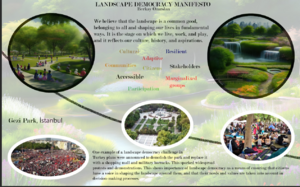
* '''Berkay Özarslan,Manifesto, Gezi Park, İstanbul. Link''': https://drive.google.com/file/d/1vliiu2ldQ99OPiQNjdCwKV_hOUQo9oWy/view?usp=share_link
* '''Berkay Özarslan,Manifesto, Gezi Park, İstanbul. Link''': https://drive.google.com/file/d/1vliiu2ldQ99OPiQNjdCwKV_hOUQo9oWy/view?usp=share_link[[File:Manifesto'.png|thumb]]
* add link here
* add link here
* add link here
* add link here
Line 17:
Line 17:
'''Berkay Özarslan, 'İstanbul Not for Sale' Movement''' :https://docs.google.com/presentation/d/e/2PACX-1vTudKq3v8c_pyCXWw7qKY_oIG3saTxurhjN4xrOLAT8gxL_nmF-Rz6cBT4V-GLa98oDzt9YNrp9nsuT/pub?start=false&loop=false&delayms=3000
'''Berkay Özarslan, 'İstanbul Not for Sale' Movement'''
[[File:Gezi Park.png|thumb|Taksim, Gezi Park, 2013 ]]
During a period of rapid urban development and gentrification in Turkey, early 2013s, . Many historic neighborhoods and green spaces in the city were being demolished. The government had announced plans to demolish the Gezi Park in Taksim Square and replace it with a shopping mall, which sparked a wave of protests across the country. The activists saw this as a threat to the democratic rights of citizens to participate in decision-making processes that impact their lives and their environment. •The movement was led by young designers who used their creative skills to mobilize support and raise awareness about the importance of preserving public spaces and green areas in the city. •The Istanbul Not For Sale campaign worked with urban planners and architects to develop alternative models of urban development that were more participatory and sustainable. They organized workshops and public forums where residents could share their ideas and concerns about the future of their neighborhoods •Through their efforts, the Istanbul Not For Sale campaign succeeded in raising awareness about the negative impacts of urban development and promoting alternative models of urban planning that were more participatory, sustainable, and equitable.
Link to the presentation :https://docs.google.com/presentation/d/e/2PACX-1vTudKq3v8c_pyCXWw7qKY_oIG3saTxurhjN4xrOLAT8gxL_nmF-Rz6cBT4V-GLa98oDzt9YNrp9nsuT/pub?start=false&loop=false&delayms=3000
Which linguistic and cultural perspectives are you representing? Which disciplinary backgrounds? Berkay Özarslan: I graduated from Ege University in Turkey with title 'Landscape Architect' in 2022 and I wanted to develop this profession further more with master degree, During my university year I attended several design workshops voluntarily. I had a chance to study in SGGW, Warsaw for 1 semester with Erasmus Programme. My aim in my professional life is to make sustainable Landscape designs that inspires people.
Your Landscape Democracy Manifestoes
Here you can add links to the manifestoes you have presented on April 26
During a period of rapid urban development and gentrification in Turkey, early 2013s, . Many historic neighborhoods and green spaces in the city were being demolished. The government had announced plans to demolish the Gezi Park in Taksim Square and replace it with a shopping mall, which sparked a wave of protests across the country. The activists saw this as a threat to the democratic rights of citizens to participate in decision-making processes that impact their lives and their environment. •The movement was led by young designers who used their creative skills to mobilize support and raise awareness about the importance of preserving public spaces and green areas in the city. •The Istanbul Not For Sale campaign worked with urban planners and architects to develop alternative models of urban development that were more participatory and sustainable. They organized workshops and public forums where residents could share their ideas and concerns about the future of their neighborhoods •Through their efforts, the Istanbul Not For Sale campaign succeeded in raising awareness about the negative impacts of urban development and promoting alternative models of urban planning that were more participatory, sustainable, and equitable.
In the session on May 17 you will present a small role play with your team. Please add here a short reflection on what you have learned from this play
Empathy and perspective-taking: By immersing myself in the role of an activist and discussing a topic from their point of view, I can develop empathy and a deeper understanding of the challenges, motivations, and values that drive activists. This exercise encourages me to step into someone else's eyes and consider their experiences and perspectives.
Readings, concepts and definitions
Start: April 5, 2023
Due: July 5, 2023
Working in your group, express your personal understanding of the relation of landscape and democracy in the form of a concept map with linking words or any other diagrammatic representation.
Please make your maps very visual and not just verbal. Think critically about why one map differs from another
You can use any tool you like for producing your concept map. However, since the result needs to be submitted digitally we recommend the following open source software for producing your maps:
Cmap Tools >>> you can also work with your group on the Cmap cloud doing a shared map