Democratic Landscape Transformation 2025 - Team 11: Difference between revisions
| (64 intermediate revisions by the same user not shown) | |||
| Line 12: | Line 12: | ||
''Please present your team briefly. Which linguistic and cultural perspectives does each member bring in? Which disciplinary backgrounds are present in your team? Note: if you prefer to stay anonymous on this wiki, you can also use initials only or a nick name'' | ''Please present your team briefly. Which linguistic and cultural perspectives does each member bring in? Which disciplinary backgrounds are present in your team? Note: if you prefer to stay anonymous on this wiki, you can also use initials only or a nick name'' | ||
*Aya Khattab, I am an Architecture Engineer with a Bachelor's degree from Cairo University, Egypt, earned in 2014. Over the past seven years, I have gained extensive and hands-on experience in the fields of architecture and landscape design. My curiosity and passion have always been centered on how we can create and manage public spaces that are not only visually compelling but also responsive to the real needs of their users. This interest drives me this year to start my masters degree in IMLA program in Germany. | *'''Aya Khattab''', I am an Architecture Engineer with a Bachelor's degree from Cairo University, Egypt, earned in 2014. Over the past seven years, I have gained extensive and hands-on experience in the fields of architecture and landscape design. My curiosity and passion have always been centered on how we can create and manage public spaces that are not only visually compelling but also responsive to the real needs of their users. This interest drives me this year to start my masters degree in IMLA program in Germany. | ||
*Morgan Ip, I am a researcher and teacher at the scales of material culture, architecture, landscapes and cities with a regional expertise in the Arctic. I have a Master's in Architecture from Carleton University in Canada and a PhD from the Oslo School of Architecture and Design in Norway. I have worked with communities and employ collaborative and participatory practices to map, visualize and analyze local and historical context to inform architecture and urban design, planning and decision-making. Linguistic and cultural perspectives: I was born in Canada with mixed European and Asian heritage and am a native English speaker, and have intermediate language abilities in French and Norwegian. I moved from a small industrial city with typical North-American car-centric and suburban planning, to Ottawa for my education. I lived in Toronto for a year before moving to Oslo for my PhD and then to the UK for a postdoc at the Scott Polar Research Institute, University of Cambridge. I am | *'''Morgan Ip''', I am a researcher and teacher at the scales of material culture, architecture, landscapes and cities with a regional expertise in the Arctic. I have a Master's in Architecture from Carleton University in Canada and a PhD from the Oslo School of Architecture and Design in Norway. I have worked with communities and employ collaborative and participatory practices to map, visualize and analyze local and historical context to inform architecture and urban design, planning and decision-making. Linguistic and cultural perspectives: I was born in Canada with mixed European and Asian heritage and am a native English speaker, and have intermediate language abilities in French and Norwegian. I moved from a small industrial city with typical North-American car-centric and suburban planning, to Ottawa for my education. I lived in Toronto for a year before moving to Oslo for my PhD and then to the UK for a postdoc at the Scott Polar Research Institute, University of Cambridge. I am honored to participate in OLA to keep abreast of methods and the extraordinary set of contexts with which to understand landscape democracy. | ||
* | *'''Negar Dokouhaki''', I am a master’s student in Architecture and Creative Practices for City and Landscape at the University of Bologna, Italy. With a foundation in architecture and a growing interest in urban design, and urban planning. my academic and creative work explores how cities and landscapes can be shaped through socially responsive and environmentally conscious design strategies. I am particularly drawn to themes of public space, ecological resilience, and community participation. My current studies aim to bridge design practice with critical thinking to foster more inclusive and adaptive urban environments | ||
* | *'''Angelo Mañego''', I am currently taking up a Bachelor’s degree in Landscape Architecture at Bulacan State University. I grew up on a farm, surrounded by nature, and most of my childhood was spent outdoors—running through fields, picking fruits, and enjoying the quiet of the land. Those memories shaped how I see the world and made me appreciate the beauty and value of natural spaces. That is what inspired me to take this path. I want to become a certified landscape designer someday so I can create places that bring people the same feeling of peace, joy, and connection that I experienced growing up. I joined OLA because I know I still have a lot to learn. I want to grow not just in design, but also in understanding how to work with different people and communities, and how to create spaces that are fair, thoughtful, and welcoming for everyone. | ||
* | *'''A.B''', I am a student at HfWU studying in the International Masters of Landscape Architecture (IMLA). I have a bachelor in Landscape Architecture. I am curious about landscapes that are overlooked for due to their hidden significance that is not directly observable, and how they can be preserved and/or improved, primarily for non-humans. | ||
==Your Landscape Democracy Manifestoes (Phase A) == | ==Your Landscape Democracy Manifestoes (Phase A) == | ||
'' | * '''Aya Khattab''' [https://drive.google.com/file/d/1RU-VLI-37we2PUrZ-GdGhhVacA2erBmy/view?usp=drive_link manifesto] | ||
* | *'''Morgan Ip [https://drive.google.com/file/d/1PfLC-JUUmMkDB89xuhlEEso7Ro3NBXgO/view?usp=drive_link manifesto]''' | ||
* | *'''Negar Dokouhaki''' , [https://drive.google.com/file/d/1iRs6nnD-y0IPYbijO0mHOmQCOoj4Z3LP/view?usp=sharing Manifestone] | ||
* | *'''Angelo Mañego,''' [https://drive.google.com/file/d/1LgTFfHCi6iWuBTmWRgoqjbQnV4iYAI3B/view?usp=sharing Manifesto] | ||
* | *'''A,''' Coast of Beirut[[File:Manifesto - A.png|thumb|Manifesto for the Coast of Beirut, Lebanon|721x721px|none]] | ||
== Entering the Process: Activism, Community and Power (Phase B) == | == Entering the Process: Activism, Community and Power (Phase B) == | ||
| Line 37: | Line 34: | ||
On May 14, every team member introduces a landscape democracy activist/or design activist individual or group. Please add the people you introduced, you may also add the presentation material used with a downloadable link: | On May 14, every team member introduces a landscape democracy activist/or design activist individual or group. Please add the people you introduced, you may also add the presentation material used with a downloadable link: | ||
*Aya Khattab, The presented activist is | *Aya Khattab, The presented activist is [[wikipedia:Christopher_Alexander|Christophe Alexander]] | ||
* | *Morgan Ip, presented as Jane Jacobs walking along Beirut's waterfront | ||
* | *Negar Dokouhaki, presented [[wikipedia:Nader_Ardalan|Nader Ardalan]] as the activist. | ||
* | *Angelo Mañego, the selected activist is the late Gina Lopez (PH). (Get to know her through this link) [https://e360.yale.edu/features/how-an-activist-minister-in-the-philippines-took-on-the-mining-barons-gina-lopez] | ||
* | *A, presented Mona Fawaz as an activist for the peoples right to Beirut's waterfront | ||
[[File:Activists.png|thumb|551x551px|Activists selected by participants for the roleplay assignment|none]] | |||
== Your Team's Landscape Democracy Challenge (Phase B) == | == Your Team's Landscape Democracy Challenge (Phase B) == | ||
* Due: May 21 | * Due: May 21 | ||
=== Context and Location === | === Context and Location === | ||
'' | The Democracy challenge we worked on is within Lebanon along the coast. '''Land reclamation''' and '''encroachment''' for the purpose of private development has led to a majority of the coastline to become inaccessible due to privatization. The specific site chosen was that of '''Dalieh''', one of the last remaining publicly accessible beaches found west of '''Beirut''', the capital of '''Lebanon''', in the mixed residential and commercial neighbourhood of '''Raouche'''. It holds thousands of years of history dating back to the palaeolithic and bronze age. People currently use this space for fishing, diving, swimming, informal housing, and now recently Plans for a new resort on the beach | ||
The rocky beach is composed of '''limestone''' and '''marl''' which have eroded over time to create a diverse set of geomorphological features, most notably the Pigeon Rocks, which are a natural postcard image of '''Beirut'''. These features also offer a multitude of habitats including caves, cliffs, and tidal pools. | |||
=== Landscape and Community Map === | === Landscape and Community Map === | ||
''Present here a visual representation of the landscape and community context of the area. What are the main spatial features? Which actors can you identify and how are they related to the area? Which values exist and for whom? What is at risk and why? Try to generate creative/conceptual/synthetic representation'' | ''Present here a visual representation of the landscape and community context of the area. What are the main spatial features? Which actors can you identify and how are they related to the area? Which values exist and for whom? What is at risk and why? Try to generate creative/conceptual/synthetic representation''[[File:Community and landscape map.png|thumb|Community and landscape map|591x591px|none]] | ||
=== Landscape and power === | |||
[[File:Landscape and Power.jpg|thumb|590x590px|Landscape and Power|none]] | |||
=== Power Map === | === Power Map === | ||
''Based on the landscape and community context depicted above: How is power distributed? Who and what has a lot of power? Who and what has no power? Who and what is strongly affected by the landscape democracy challenges? Who and what is less affected? Are these actors connected or disconnected? Any veto-players known? Try to generate creative/conceptual/synthetic representation'' | ''Based on the landscape and community context depicted above: How is power distributed? Who and what has a lot of power? Who and what has no power? Who and what is strongly affected by the landscape democracy challenges? Who and what is less affected? Are these actors connected or disconnected? Any veto-players known? Try to generate creative/conceptual/synthetic representation'' | ||
[[File:Power map Group 11.png|thumb|590x590px|Power Map|none]] | |||
== Your Team's Landscape Democracy Vision and Ideas (Phase C) == | == Your Team's Landscape Democracy Vision and Ideas (Phase C) == | ||
| Line 73: | Line 74: | ||
'''You can present your results in this gallery:''' | '''You can present your results in this gallery:''' | ||
File: | [[File:The Nominal Group Technique.jpg|thumb|646x646px|'''The Nominal Group Technique (NGT) is a structured brainstorming method'''|none]] | ||
File: | |||
File: | [[File:Prototyping as engagement.jpg|thumb|645x645px|Prototyping as engagement|none]] | ||
[[File:Impact evaluation and values chain.jpg|thumb|645x645px|Impact evaluation and values chain|none]] | |||
== Cross-cutting activity: Readings, concepts and definitions (Phases A - D) == | == Cross-cutting activity: Readings, concepts and definitions (Phases A - D) == | ||
| Line 96: | Line 102: | ||
=== How to present your concept maps === | === How to present your concept maps === | ||
* We give you below a draft image gallery where you can add pictures of your map (in JPG or PNG format) | * We give you below a draft image gallery where you can add pictures of your map (in JPG or PNG format) | ||
* You can present your integrated understanding as one concept map '''or''' your present individual ones '''and''' the integrated one. | * You can present your integrated understanding as one concept map '''or''' your present individual ones '''and''' the integrated one. | ||
* add as many additional materials as you need | * add as many additional materials as you need | ||
===Overview of your concept maps (individual and integrated)=== | |||
[[File:DEMOCRATIC LANDSCAPE- ANGELO MAÑEGO.png|none|thumb|525x525px|'''ANGELO MAÑEGO - Democratic Landscape concept map''']] | |||
[[File:Negar conceptual map.png|none|thumb|525x525px|'''Negar Dokouhaki - Democratic Landscape concept map''']] | |||
[[File:Concept map (2).png|none|thumb|534x534px|'''Aya Khattab - Democratic Landscape concept map''' ]] | |||
[[File:Morgan Ip Concept Map.png|thumb|Morgan Ip - Democratic Landscape concept map|none|538x538px]] | |||
[[File:Concept map OLA.png|thumb|A - Democratic Landscape concept map|none|540x540px]] | |||
=== | === Integrated Concept Map === | ||
[[File:Concept Map integrated.jpg|none|thumb|756x756px|Integrated concept map -group 11]] | |||
File: | |||
== Please finish with a short reflection (Phase D) == | == Please finish with a short reflection (Phase D) == | ||
Due: July 9, 2025 | Due: July 9, 2025 | ||
* | === Similarities === | ||
* | |||
* Rights of nature - Not only people who has the right to form and contribute in shaping the landscape, but also all other living being also have the right in nature, existence, and contribution. | |||
* Individual contribution and responsibility are key role for a successful democratic landscape. | |||
* Landscaped should be designed by people, and government contributions. | |||
* Incentive for engagement and community coherence. | |||
* Justice and respect for democracy. | |||
Our team shares a common understanding that democratic landscape transformation (DLT) is a participatory and inclusive process where landscapes are shaped by the people who use and inhabit them. We all emphasize the importance of community engagement, access, inclusion, and justice. However, each person highlighted different aspects: one focused on unity through culture and environment, another on systemic contributors and values like transparency and responsibility, and another emphasized theoretical grounding and participatory methods. These variations show a shared foundation with diverse emphases on social, cultural, and procedural dimensions of DLT. | |||
=== Understandings === | |||
* The course clarifies the concepts of landscape such as right for accessibility, mobility, community contribution in design. | |||
* How the Power map works, demonstrate how community map and power forces can change the democratic transformation. | |||
The seminar lectures and readings were instrumental in deepening our understanding of democratic landscape transformation by providing theoretical frameworks, real-world examples, and participatory tools. They clarified key concepts such as spatial justice, co-design, and landscape as a reflection of power and identity. This allowed us to move beyond abstract ideas and develop a more structured, inclusive, and action-oriented view of how democratic landscapes can be created and sustained. | |||
=== Taking home messages === | |||
* Community Involvement in shaping their places. | |||
* Individual responsibility towards landscape and community. | |||
From this seminar, we take home the understanding that landscape is not just a physical space but a living, social environment shaped by collective memory, identity, and governance. We learned that transforming landscapes democratically means centering community voices, especially those often marginalized, and promoting justice, inclusion, and shared responsibility. Most importantly, we leave with tools and perspectives that empower us to co-create spaces with people, not just for them. | |||
[[Category:OLA Working Group 2025]] | [[Category:OLA Working Group 2025]] | ||
Latest revision as of 21:59, 9 July 2025
>>> Back to working group overview
>>> Back to seminar reading list, session materials & recordings
>>> go to the Editing Help
Seminar process at a glance

Background of your team
Please present your team briefly. Which linguistic and cultural perspectives does each member bring in? Which disciplinary backgrounds are present in your team? Note: if you prefer to stay anonymous on this wiki, you can also use initials only or a nick name
- Aya Khattab, I am an Architecture Engineer with a Bachelor's degree from Cairo University, Egypt, earned in 2014. Over the past seven years, I have gained extensive and hands-on experience in the fields of architecture and landscape design. My curiosity and passion have always been centered on how we can create and manage public spaces that are not only visually compelling but also responsive to the real needs of their users. This interest drives me this year to start my masters degree in IMLA program in Germany.
- Morgan Ip, I am a researcher and teacher at the scales of material culture, architecture, landscapes and cities with a regional expertise in the Arctic. I have a Master's in Architecture from Carleton University in Canada and a PhD from the Oslo School of Architecture and Design in Norway. I have worked with communities and employ collaborative and participatory practices to map, visualize and analyze local and historical context to inform architecture and urban design, planning and decision-making. Linguistic and cultural perspectives: I was born in Canada with mixed European and Asian heritage and am a native English speaker, and have intermediate language abilities in French and Norwegian. I moved from a small industrial city with typical North-American car-centric and suburban planning, to Ottawa for my education. I lived in Toronto for a year before moving to Oslo for my PhD and then to the UK for a postdoc at the Scott Polar Research Institute, University of Cambridge. I am honored to participate in OLA to keep abreast of methods and the extraordinary set of contexts with which to understand landscape democracy.
- Negar Dokouhaki, I am a master’s student in Architecture and Creative Practices for City and Landscape at the University of Bologna, Italy. With a foundation in architecture and a growing interest in urban design, and urban planning. my academic and creative work explores how cities and landscapes can be shaped through socially responsive and environmentally conscious design strategies. I am particularly drawn to themes of public space, ecological resilience, and community participation. My current studies aim to bridge design practice with critical thinking to foster more inclusive and adaptive urban environments
- Angelo Mañego, I am currently taking up a Bachelor’s degree in Landscape Architecture at Bulacan State University. I grew up on a farm, surrounded by nature, and most of my childhood was spent outdoors—running through fields, picking fruits, and enjoying the quiet of the land. Those memories shaped how I see the world and made me appreciate the beauty and value of natural spaces. That is what inspired me to take this path. I want to become a certified landscape designer someday so I can create places that bring people the same feeling of peace, joy, and connection that I experienced growing up. I joined OLA because I know I still have a lot to learn. I want to grow not just in design, but also in understanding how to work with different people and communities, and how to create spaces that are fair, thoughtful, and welcoming for everyone.
- A.B, I am a student at HfWU studying in the International Masters of Landscape Architecture (IMLA). I have a bachelor in Landscape Architecture. I am curious about landscapes that are overlooked for due to their hidden significance that is not directly observable, and how they can be preserved and/or improved, primarily for non-humans.
Your Landscape Democracy Manifestoes (Phase A)
- Aya Khattab manifesto
- Morgan Ip manifesto
- Negar Dokouhaki , Manifestone
- Angelo Mañego, Manifesto
- A, Coast of Beirut
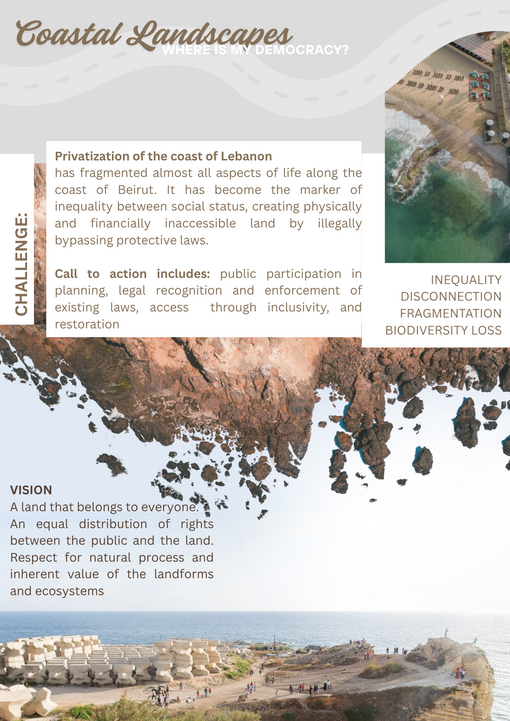
Manifesto for the Coast of Beirut, Lebanon

Entering the Process: Activism, Community and Power (Phase B)
Global Landscape Democracy Role Models and Design Activism
- Due: May 14
At the beginning of phase B we ask you to identify people who are already active for democratic landscape transformation. These can be planners and designers, NGOs, collectives or activists, or people operating creatively at the interface of these categories. 'Design activism' is a possible overarching category. We created a list some time ago, but it has a very US/European focus, due to the history of our project. We really want to expand this and hope you can bring in new people and movements from around the globe.
On May 14, every team member introduces a landscape democracy activist/or design activist individual or group. Please add the people you introduced, you may also add the presentation material used with a downloadable link:
- Aya Khattab, The presented activist is Christophe Alexander
- Morgan Ip, presented as Jane Jacobs walking along Beirut's waterfront
- Negar Dokouhaki, presented Nader Ardalan as the activist.
- Angelo Mañego, the selected activist is the late Gina Lopez (PH). (Get to know her through this link) [1]
- A, presented Mona Fawaz as an activist for the peoples right to Beirut's waterfront

Your Team's Landscape Democracy Challenge (Phase B)
- Due: May 21
Context and Location
The Democracy challenge we worked on is within Lebanon along the coast. Land reclamation and encroachment for the purpose of private development has led to a majority of the coastline to become inaccessible due to privatization. The specific site chosen was that of Dalieh, one of the last remaining publicly accessible beaches found west of Beirut, the capital of Lebanon, in the mixed residential and commercial neighbourhood of Raouche. It holds thousands of years of history dating back to the palaeolithic and bronze age. People currently use this space for fishing, diving, swimming, informal housing, and now recently Plans for a new resort on the beach
The rocky beach is composed of limestone and marl which have eroded over time to create a diverse set of geomorphological features, most notably the Pigeon Rocks, which are a natural postcard image of Beirut. These features also offer a multitude of habitats including caves, cliffs, and tidal pools.
Landscape and Community Map
Present here a visual representation of the landscape and community context of the area. What are the main spatial features? Which actors can you identify and how are they related to the area? Which values exist and for whom? What is at risk and why? Try to generate creative/conceptual/synthetic representation

Landscape and power

Power Map
Based on the landscape and community context depicted above: How is power distributed? Who and what has a lot of power? Who and what has no power? Who and what is strongly affected by the landscape democracy challenges? Who and what is less affected? Are these actors connected or disconnected? Any veto-players known? Try to generate creative/conceptual/synthetic representation

Your Team's Landscape Democracy Vision and Ideas (Phase C)
- Due: June 18
Collective Vision
If you were to redesign the power map of your area and start a process of democratic landscape transformation: Which long term-goal could keep the process going? What could be a collective vision that integrates the goals of your team? Give a name to your vision. Try to generate creative/conceptual/synthetic representation.
A prototype of the first step
How would you enter the process? Which prototype could activate it? How would you introduce the prototype to the community?
You can present your results in this gallery:


Cross-cutting activity: Readings, concepts and definitions (Phases A - D)
- Due: July 2, 2025
While working in your group, please start to express your personal understanding of the relation of landscape and democracy in the form of a concept map with linking words or any other diagrammatic representation. Please make your maps very visual and not just verbal. Think critically about why one map differs from another.
The final product is a shared concept map that integrates the various understandings present within your team.
About concept mapping
Before starting the exercise you can read this article by Joseph D. Novak & Alberto J. Cañas about Theory Underlying Concept Maps and How to Construct and Use Them. This paper gives a good explanation of how concept maps are conceived and developed.
You can use any tool you like for producing your concept map. However, since the result needs to be submitted digitally we recommend the following open source software for producing your maps:
- Cmap Tools >>> you can also work with your group on the Cmap cloud doing a shared map
- VUE - The Visual Understanding Environment
- Use a shared whiteboard to develop your integrated concept map, such as MIRO or MURAL
How to present your concept maps
- We give you below a draft image gallery where you can add pictures of your map (in JPG or PNG format)
- You can present your integrated understanding as one concept map or your present individual ones and the integrated one.
- add as many additional materials as you need
Overview of your concept maps (individual and integrated)


.png)


Integrated Concept Map

Please finish with a short reflection (Phase D)
Due: July 9, 2025
Similarities
- Rights of nature - Not only people who has the right to form and contribute in shaping the landscape, but also all other living being also have the right in nature, existence, and contribution.
- Individual contribution and responsibility are key role for a successful democratic landscape.
- Landscaped should be designed by people, and government contributions.
- Incentive for engagement and community coherence.
- Justice and respect for democracy.
Our team shares a common understanding that democratic landscape transformation (DLT) is a participatory and inclusive process where landscapes are shaped by the people who use and inhabit them. We all emphasize the importance of community engagement, access, inclusion, and justice. However, each person highlighted different aspects: one focused on unity through culture and environment, another on systemic contributors and values like transparency and responsibility, and another emphasized theoretical grounding and participatory methods. These variations show a shared foundation with diverse emphases on social, cultural, and procedural dimensions of DLT.
Understandings
- The course clarifies the concepts of landscape such as right for accessibility, mobility, community contribution in design.
- How the Power map works, demonstrate how community map and power forces can change the democratic transformation.
The seminar lectures and readings were instrumental in deepening our understanding of democratic landscape transformation by providing theoretical frameworks, real-world examples, and participatory tools. They clarified key concepts such as spatial justice, co-design, and landscape as a reflection of power and identity. This allowed us to move beyond abstract ideas and develop a more structured, inclusive, and action-oriented view of how democratic landscapes can be created and sustained.
Taking home messages
- Community Involvement in shaping their places.
- Individual responsibility towards landscape and community.
From this seminar, we take home the understanding that landscape is not just a physical space but a living, social environment shaped by collective memory, identity, and governance. We learned that transforming landscapes democratically means centering community voices, especially those often marginalized, and promoting justice, inclusion, and shared responsibility. Most importantly, we leave with tools and perspectives that empower us to co-create spaces with people, not just for them.