Budapest-Vác Living Lab: Difference between revisions
No edit summary |
|||
| (16 intermediate revisions by the same user not shown) | |||
| Line 1: | Line 1: | ||
[[File:Group Photo Forum Budapest 2025 Cropped.jpg| | [[File:Group Photo Forum Budapest 2025 Cropped.jpg|800px|thumb|right|OLA Summer School and Landscape Forum Budapest-Vác June 2025]] | ||
== OLA Partners for the Budapest-Vác Living Lab == | == OLA Partners for the Budapest-Vác Living Lab == | ||
*'''Local living lab promoters''': MATE - Hungarian University for Agriculture and Life Sciences (university partner) and KulturAktív (NGO partner) | *'''Local living lab promoters''': MATE - Hungarian University for Agriculture and Life Sciences (university partner) and KulturAktív (NGO partner) | ||
* '''[[OLA_Project_Team#Hungary:_MATE_-_Hungarian_University_for_Agriculture_and_Life_Sciences_(university_partner)_and_KulturAkt%C3%ADv_(NGO_partner)|Team members]]''' | * '''[[OLA_Project_Team#Hungary:_MATE_-_Hungarian_University_for_Agriculture_and_Life_Sciences_(university_partner)_and_KulturAkt%C3%ADv_(NGO_partner)|Team members]]''' | ||
== Video Impressions of our Living Lab Activities == | == Video Impressions of our Living Lab Activities == | ||
| Line 83: | Line 82: | ||
* [https://ilias.hfwu.de/goto.php?target=file_44567_download&client_id=hfwu Team 5 - Turning the forest into a nature-experience space] | * [https://ilias.hfwu.de/goto.php?target=file_44567_download&client_id=hfwu Team 5 - Turning the forest into a nature-experience space] | ||
=== Impressions === | === Impressions from the OLA Intensive Programme in Vác === | ||
''Photos by Ellen Fetzer and Eunice Maina'' | |||
<gallery widths="250" heights="180"> | <gallery widths="250" heights="180"> | ||
File:OLA BIP VAC 1.JPG|Urban landscape diving into the forest | File:OLA BIP VAC 1.JPG|Urban landscape diving into the forest | ||
File:OLA BIP VAC 2.JPG| | File:OLA BIP VAC 2.JPG|We are approaching the forest | ||
File:OLA BIP VAC 3.JPG| | File:OLA BIP VAC 3.JPG|Nature frames method (1) | ||
File:OLA BIP VAC 4.JPG| | File:OLA BIP VAC 4.JPG|Nature frames method (2) | ||
File:OLA BIP VAC 5.JPG| | File:OLA BIP VAC 5.JPG|Findings pathways | ||
File:OLA BIP VAC 6.JPG| | File:OLA BIP VAC 6.JPG|Learning from the Vac Living Lab findings (1) | ||
File:OLA BIP VAC 7.JPG| | File:OLA BIP VAC 7.JPG|Learning from the Vac Living Lab findings (2) | ||
File:OLA BIP VAC 8.JPG| | File:OLA BIP VAC 8.JPG|Mapping future forest pathways (1) | ||
File:OLA BIP VAC 9.JPG| | File:OLA BIP VAC 9.JPG|Mapping future forest pathways (2) | ||
File:OLA BIP VAC 10..JPG| | File:OLA BIP VAC 10..JPG|Mapping future forest pathways (3) | ||
File:OLA BIP VAC 11..JPG| | File:OLA BIP VAC 11..JPG|Children as co-scientists (1) | ||
File:OLA BIP VAC 12..JPG| | File:OLA BIP VAC 12..JPG|Children as co-scientists (2) | ||
File:OLA BIP VAC 13.JPG| | File:OLA BIP VAC 13.JPG|Transforming the forest (1) | ||
File:OLA BIP VAC 14.JPG| | File:OLA BIP VAC 14.JPG|Transforming the forest (2) | ||
File:OLA BIP VAC 15.JPG| | File:OLA BIP VAC 15.JPG|Announcing our community event (1) | ||
File:OLA BIP VAC | File:OLA BIP VAC 17.JPG|Transfer of Vac learnings to the forum (1) | ||
File:OLA BIP VAC | File:OLA BIP VAC 18.JPG|Transfer of Vac learnings to the forum (2) | ||
File:OLA BIP VAC | File:OLA BIP VAC 19.JPG|Building the forest play landscape (1) | ||
File:OLA BIP VAC | File:OLA BIP VAC 20.JPG|Building the forest play landscape (2) | ||
File:OLA BIP VAC | File:OLA BIP VAC 21.JPG|Building the forest play landscape (3) | ||
File: | File:Forest Festival 3.jpg|Building the forest play landscape (4) | ||
File: | File:Forest Festival 2.jpg|Building the forest play landscape (5) | ||
File:OLA BIP VAC | File:Forest Festival 1.jpg|Magic light show in the forest | ||
File:OLA BIP VAC | File:OLA BIP VAC 22.JPG|Final presentation in Budapest (1) | ||
File:OLA BIP VAC 23.JPG|Final presentation in Budapest (2) | |||
</gallery> | </gallery> | ||
== Landscape Forum and Multiplier Event == | == Landscape Forum and Multiplier Event == | ||
The last multiplier event of the OLA project took place at the campus of the Hungarian University of Agriculture and Life Sciences (MATE) in Budapest, Hungary, on '''June 18, 2025.''' | |||
During the event, we will presented the outcomes of the OLA ERASMUS+ Project: Democratic Landscape Transformation: Towards an Open Landscape Academy. We shared and discussed the latest version of the [https://www.openlandscapeacademy.org/vision Charta for Democratic Landscape Transformation], we introduced our open courses on democratic landscape transformation and the OLA website, an international platform for communities and professionals to share experiences. We also presented the living labs with their stories and the specific methods they have developed. | |||
Participants were able to explore the OLA Charta – a collection of principles to guide democratic, community-based landscape planning, to learn from real-world examples – inspiring stories and key takeaways from OLA’s living labs, tocConnect with a professional community and meet practitioners who believe in democratic landscape transformation, to discover new ideas and see how the OLA approach can apply to your own urban or rural projects. Finally, new connections where formed, helping to start something together, join idea exchanges and explore opportunities for future collaboration | |||
The multiplier event was addressed to landscape architects, urbanists, architects and spatial planners, both professional and academic, professionals working in participatory and community-based design, civil society organizations, researchers, and university students. We invited anyone who believes in the power of community involvement and is looking for new methods. | |||
=== Impressions from the OLA Multiplier Event === | |||
''all Photos by Gyula Csernok | Courtesy of KultúrAktív Association'' | |||
<gallery widths="250" heights="180"> | |||
File:Multiplikátor esmény 20250618.JPG|Briefing the table moderators | |||
File:Multiplikátor esmény 20250618-5.JPG|Welcoming the participants | |||
File:Multiplikátor esmény 20250618-7.JPG|OLA postcards for sharing | |||
File:Multiplikátor esmény 20250618-10.JPG|The events hall at the MATE campus is ideal | |||
File:Multiplikátor esmény 20250618-27.JPG|Welcoming the participants | |||
File:Multiplikátor esmény 20250618-39.JPG|Anna and Istvan opening the event | |||
File:Multiplikátor esmény 20250618-53.JPG|Playing 'Bingo' as an icebreaker | |||
File:Multiplikátor esmény 20250618-62.JPG|Sharing our publication | |||
File:Multiplikátor esmény 20250618-84.JPG|Exploring the OLA Charta | |||
File:Multiplikátor esmény 20250618-91.JPG|Anna leads the reflection process | |||
File:Multiplikátor esmény 20250618-92.JPG|Participants study the Charta for themselves first | |||
File:Multiplikátor esmény 20250618-108.JPG|Then exchange... | |||
File:Multiplikátor esmény 20250618-120.JPG|...with people on their tables | |||
File:Multiplikátor esmény 20250618-143.JPG|...and leave valuable comments on the Charta | |||
File:Multiplikátor esmény 20250618-147.JPG|Living Lab teams present the stories and methods from the OLA labs | |||
File:Multiplikátor esmény 20250618-168.JPG|People connect to the community and the project. | |||
File:Multiplikátor esmény 20250618-198.JPG|We harvest the findings... | |||
File:Multiplikátor esmény 20250618-206.JPG|...to develop OLA further. | |||
</gallery> | |||
=== Landscape Forum Working Group Presentations === | |||
* [https://ilias.hfwu.de/goto.php?target=file_44558_download&client_id=hfwu Working Group 1: Building resilient urban peripheries] | * [https://ilias.hfwu.de/goto.php?target=file_44558_download&client_id=hfwu Working Group 1: Building resilient urban peripheries] | ||
* [https://ilias.hfwu.de/goto.php?target=file_44559_download&client_id=hfwu Working Group 2: Foodscapes for Vác] | * [https://ilias.hfwu.de/goto.php?target=file_44559_download&client_id=hfwu Working Group 2: Foodscapes for Vác] | ||
| Line 120: | Line 154: | ||
== Publications and Further Resources == | == Publications and Further Resources == | ||
*Tóth, E., Szilágyi-Nagy, A., Földi, Z., & Valánszki, I. (2025). Reconnecting Children with Nature in Urban Space. 4D Journal of Landscape Architecture and Garden Art, 76, 16-23. https://doi.org/10.36249/4d.76.6427 | |||
*Tóth, E., Szilágyi-Nagy (2925): Naturerfahrungen von Kindern in urbanen Räumen fördern, [https://bwsyncandshare.kit.edu/s/XGS42i6JqN4AkX4 download poster] (Conference contribution) | |||
== ERASMUS+ Programme & Partners== | |||
Funded by the European Union. Views and opinions expressed are however those of the author(s) only and do not necessarily reflect those of the European Union or the European Education and Culture Executive Agency (EACEA). Neither the European Union nor EACEA can be held responsible for them. | |||
[[File:231213-OLA-Logoleiste-V2-transparent.png|2000px]] | |||
Latest revision as of 08:16, 9 January 2026

OLA Partners for the Budapest-Vác Living Lab
- Local living lab promoters: MATE - Hungarian University for Agriculture and Life Sciences (university partner) and KulturAktív (NGO partner)
- Team members
Video Impressions of our Living Lab Activities
Background of the Budapest-Vác Living Lab
Transformation of the LADDER Living Lab – OLA Focus on Vác
The LADDER Living Lab began as a platform for involving children and young people in the democratic transformation of their everyday environments. After several years of community-based schoolyard design, the Living Lab broadened its mission toward a larger goal: supporting child-friendly urban development through democratic landscape transformation.
Building on the “Shape Your School” brand and earlier schoolyard co-design projects, the Living Lab expanded its scope to engage not only individual schools but the wider community of Vác. This shift allowed us to explore how children and families experience the city and how their perspectives can actively shape urban planning.
Achievements in Vác
Deepened community involvement: The Living Lab established strong cooperation with local institutions, schools, NGOs, municipal actors, and residents. A series of community discussions, workshops, and public events brought together families, teachers, merchants, cultural institutions, environmental educators, seniors, and youth. These activities helped gather collective memories, map beloved places, and identify barriers to independent mobility and access to nature.
School-based learning and co-design: Landscape architecture students facilitated interactive sessions in several primary schools in Vác. These activities combined environmental education with participatory design, enabling children to express how they connect with nature and what improvements they envision for their school grounds and neighbourhoods. Students also conducted research to understand children’s perceptions of green spaces and the broader urban environment.
City-wide research and community mapping: The Living Lab carried out an extensive survey involving hundreds of residents to assess public perceptions of green and community spaces. This work—including interviews, questionnaires, archival research, and on-site observation—laid the groundwork for identifying key sites for future community-led planning and interventions.
Capacity building and professional training: The Living Lab developed and shared methods of participatory planning with professionals, university students, teachers, and municipal representatives. Workshops and presentations strengthened local skills for engaging youth in landscape transformation and promoted the Living Lab’s tools and approaches nationally.
Goals for the Child-Friendly Vác Project
The current phase of the Living Lab focuses on making Vác a more child-friendly, nature-oriented city. This includes:
- Exploration: Understanding how children connect with nature in different parts of Vác and identifying challenges in the urban environment.
- Visioning and Planning: Co-creating a shared vision and concrete plans that offer children more opportunities to explore, learn from, and enjoy nature in their everyday lives.
- Implementation: Introducing landscape interventions in public spaces that strengthen children’s relationship with nature and contribute to a healthier, more playful and inclusive urban environment.
Through these steps, the Living Lab aims to embed children’s voices into urban decision-making and demonstrate how democratic landscape transformation can improve community well-being. The work in Vác serves as a replicable case study showing how cities can meaningfully involve young people in shaping their surroundings and building a more livable future.
Location of the Budapest-Vác Living Lab
OLA Workshop June 2025
The OLA Community traveled to Vác in Hungary from June 13 - 22, 2025. In total, 45 participants from all project partners attended in the roles of student participants, group supervisors and coordinators. The workshop build very well on the previous activities of the Living Lab with a clear thematic focus on the child-friendly approach and a spatial focus on the Törökhegy Forest. This small forest has been identified as a potential development area for nature play and nature experience. The forest was planted in the 1950's as a shelter for emissions of the local cement factory, together with a few other forest patches of similar size all around the eastern periphery of Vác. Today, the area is rather unused and there is little to no management of its vegetation.
The workshop was a great opportunity for re-discovering the potential of this natural area for an evolving neighborhood and its community. The activities were well balanced between discovery, analysis, empathizing, prototyping, engagement and visioning. The event was done in parallel to the annual landscape forum and created interesting synergies. An OLA multiplier event was hosted together.
Working group results
- Team 1 - Green Space Integration: Nourishing dreams under the trees
- Team 2 - Forest Management: The guardians of the forest
- Team 3 - Building belonging through play
- Team 4 - Towards a universally accessible urban forest
- Team 5 - Turning the forest into a nature-experience space
Impressions from the OLA Intensive Programme in Vác
Photos by Ellen Fetzer and Eunice Maina
-
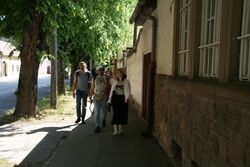 Urban landscape diving into the forest
 -
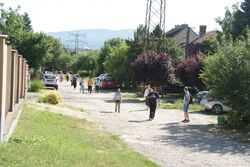 We are approaching the forest
 -
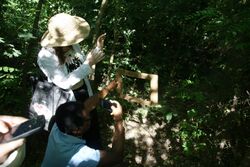 Nature frames method (1)
 -
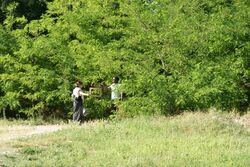 Nature frames method (2)
 -
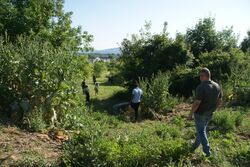 Findings pathways
 -
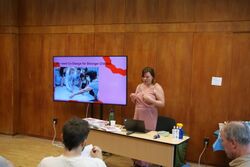 Learning from the Vac Living Lab findings (1)
 -
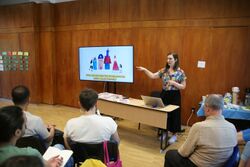 Learning from the Vac Living Lab findings (2)
 -
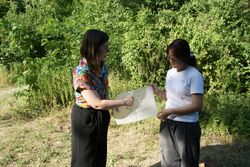 Mapping future forest pathways (1)
 -
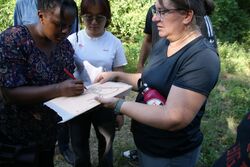 Mapping future forest pathways (2)
 -
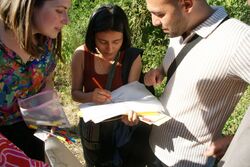 Mapping future forest pathways (3)
 -
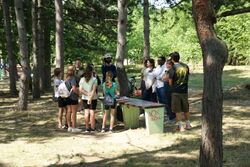 Children as co-scientists (1)
 -
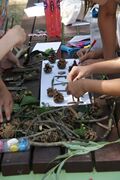 Children as co-scientists (2)
 -
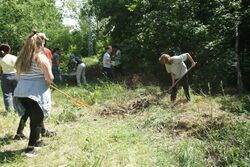 Transforming the forest (1)
 -
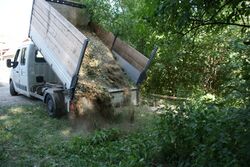 Transforming the forest (2)
 -
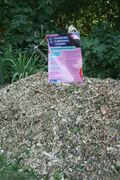 Announcing our community event (1)
 -
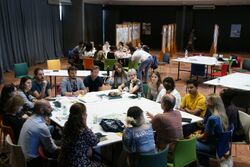 Transfer of Vac learnings to the forum (1)
 -
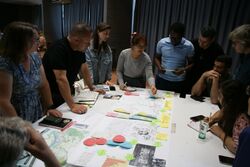 Transfer of Vac learnings to the forum (2)
 -
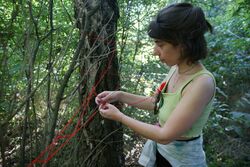 Building the forest play landscape (1)
 -
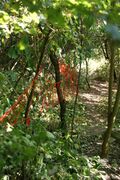 Building the forest play landscape (2)
 -
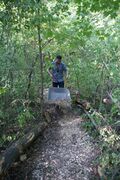 Building the forest play landscape (3)
 -
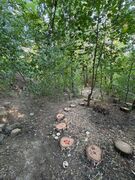 Building the forest play landscape (4)
 -
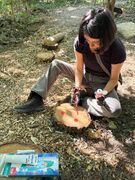 Building the forest play landscape (5)
 -
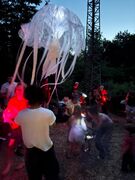 Magic light show in the forest
 -
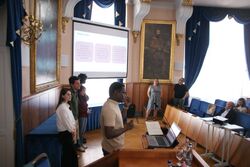 Final presentation in Budapest (1)
 -
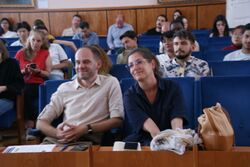 Final presentation in Budapest (2)


Landscape Forum and Multiplier Event
The last multiplier event of the OLA project took place at the campus of the Hungarian University of Agriculture and Life Sciences (MATE) in Budapest, Hungary, on June 18, 2025. During the event, we will presented the outcomes of the OLA ERASMUS+ Project: Democratic Landscape Transformation: Towards an Open Landscape Academy. We shared and discussed the latest version of the Charta for Democratic Landscape Transformation, we introduced our open courses on democratic landscape transformation and the OLA website, an international platform for communities and professionals to share experiences. We also presented the living labs with their stories and the specific methods they have developed.
Participants were able to explore the OLA Charta – a collection of principles to guide democratic, community-based landscape planning, to learn from real-world examples – inspiring stories and key takeaways from OLA’s living labs, tocConnect with a professional community and meet practitioners who believe in democratic landscape transformation, to discover new ideas and see how the OLA approach can apply to your own urban or rural projects. Finally, new connections where formed, helping to start something together, join idea exchanges and explore opportunities for future collaboration
The multiplier event was addressed to landscape architects, urbanists, architects and spatial planners, both professional and academic, professionals working in participatory and community-based design, civil society organizations, researchers, and university students. We invited anyone who believes in the power of community involvement and is looking for new methods.
Impressions from the OLA Multiplier Event
all Photos by Gyula Csernok | Courtesy of KultúrAktív Association
-
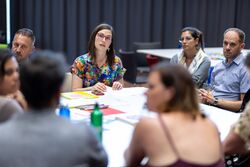 Briefing the table moderators
 -
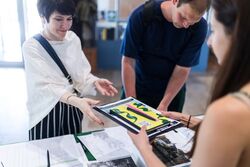 Welcoming the participants
 -
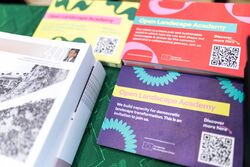 OLA postcards for sharing
 -
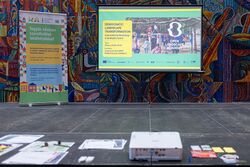 The events hall at the MATE campus is ideal
 -
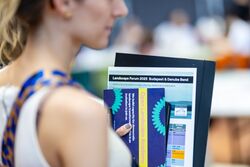 Welcoming the participants
 -
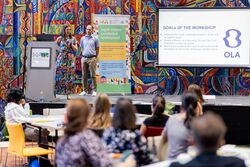 Anna and Istvan opening the event
 -
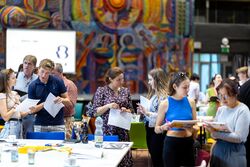 Playing 'Bingo' as an icebreaker
 -
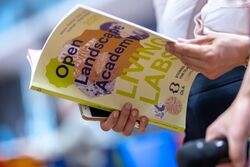 Sharing our publication
 -
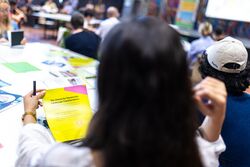 Exploring the OLA Charta
 -
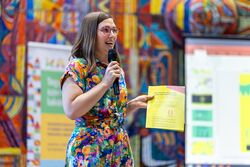 Anna leads the reflection process
 -
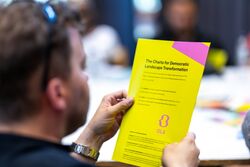 Participants study the Charta for themselves first
 -
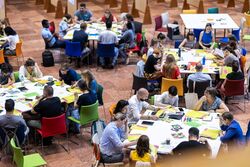 Then exchange...
 -
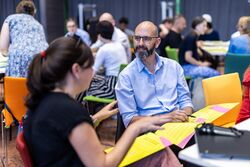 ...with people on their tables
 -
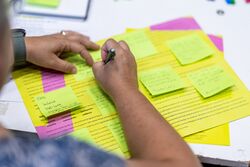 ...and leave valuable comments on the Charta
 -
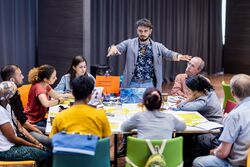 Living Lab teams present the stories and methods from the OLA labs
 -
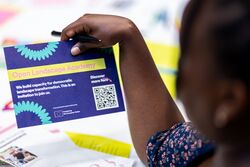 People connect to the community and the project.
 -
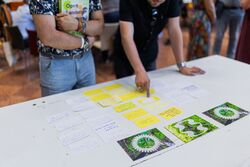 We harvest the findings...
 -
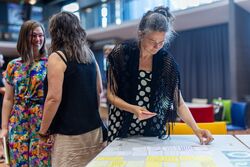 ...to develop OLA further.


Landscape Forum Working Group Presentations
- Working Group 1: Building resilient urban peripheries
- Working Group 2: Foodscapes for Vác
- Working Group 3: Towards a Living Landscape Biography
- Working Group 4: Mobility Landscapes Vác
- Working Group 5: Landscape Democracy
Publications and Further Resources
- Tóth, E., Szilágyi-Nagy, A., Földi, Z., & Valánszki, I. (2025). Reconnecting Children with Nature in Urban Space. 4D Journal of Landscape Architecture and Garden Art, 76, 16-23. https://doi.org/10.36249/4d.76.6427
- Tóth, E., Szilágyi-Nagy (2925): Naturerfahrungen von Kindern in urbanen Räumen fördern, download poster (Conference contribution)
ERASMUS+ Programme & Partners
Funded by the European Union. Views and opinions expressed are however those of the author(s) only and do not necessarily reflect those of the European Union or the European Education and Culture Executive Agency (EACEA). Neither the European Union nor EACEA can be held responsible for them.
